|
Propshield Industrial is fast becoming
recognised throughout the maritime world as the
market leader in commercial propeller antifouling, saving companies thousands of
pounds/dollars in saved fuel and reduced propeller repair, replacement and cleaning bills. With
current fuel prices sky rocketing around the world
Propshield Industrial
will
ensure your company keeps its competitive edge.
Building on the success of its retail sibling, see
www.prop-shield.com for
details,
Propshield Industrial
increases product strength,
durability and ease of application ensuring it's well up to the
task of protecting all types and sizes of vessel, from supertankers to superyachts
and from cruise liners to trawlers,
in the most testing of environments.
Propshield Industrial
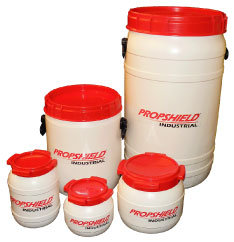
is a paste and comes in 4 available sizes, 2.75 Litre, 5.5
Litre, 10 litre and 60 Litre Kegs/Barrels. Please see our
coverage
table for information on propeller sizes and the
number that each keg/barrel can treat.
How
it works
Propshield Industrial
has a lanolin base, a substance long used by mariners for
prevention of fouling, however combine this with a special combination of
corrosion inhibitors and other chemicals an age old remedy is transformed into a
modern day solution tough enough to endure hard labour day in
day out in the toughest of climes and in the foulest of waters.
Propshield Industrial
bonds to the metal surface of a propeller in a simple 2 coat
application process. Once applied it ensures a surface is so
slippery that barnacles and hard growth are unable to securely
attach to its metal surface, oxidisation and electrolysis are
also nullified.
Important: Propshield is no substitute for a good bonding
system, the product will work in conjunction with anodes to
eradicate electrolysis.
As with all antifouling products
Propshield
Industrial
performs at its best when a vessel is used regularly; the more a
vessel is used the more barnacles and hard growth are thrown off
from the force created by the rotating propeller and the lack of
adhesion caused by the Propshield coating.
Propshield
Industrial
will also perform well even if a vessel is inactive for long
periods of time. If a vessel has seen extended inactivity simply
take to sea and run at full speed for approximately 60 minutes
and most of the barnacles and hard growth that have adhered to
the props will be thrown off.
As mentioned
Propshield
Industrial also helps to eliminate or at least
significantly reduce the effects of electrolysis preventing propellers
dissolving into the water when shore power is connected. If a
propeller is green at the end of the season this is a sure sign that
the copper is leaching out of the bronze through galvanic action. This
weakens the metal and blades can sometimes break off and penetrate the
hull. At best the blade will loose efficiency and your fuel bills will
increase as your vessel's top/optimum cruising speed falls.
Unable to be dissolved in water the Propshield coating slowly
degenerates over time leaving a transparent bonded film retained
in the very pores of the metal ensuring the product remains
active for long periods of up to 18 months. Click
here
for details on product application.
A macro
cross-section diagram of the product in action/application is shown in
Figure 1.1 below. As you can see the 1st coat of
Propshield bonds to the metal surface penetrating the pores of
the metal up to a tenth of a millimetre. The 2nd bonding coat is
then applied on top of the first in a much thicker layer. This
second coat consists of two sub layers, primary and secondary.

Fig. 1.1
2nd Bonding Coat
The
primary and thickest layer plays a critical part in protecting
the 1st bonding coat and secondary layer of the 2nd bonding coat
ensuring the products overall longevity. This primary layer also
has the shortest active lifespan of just 1 to 4 weeks, this may
seem a short time however the primary layers job will have been
achieved, protection of the secondary sub layer of the 2nd
bonding coat and the 1st bonding coat.
After the Primary
sub layer of the 2nd bonding coat has finished its active life
it will fall away to reveal the much harder secondary sub layer
of the 2nd bonding coat, this transition from primary to
secondary sub layer is known as "shedding". Shedding can occur
gradually over a few weeks or all at once depending on various
factors such as vessel usage, local sea variables and ambient
temperature during application. Regardless of the time span the
primary sub layer will only "shed" itself once the secondary sub
layer is hard enough to begin its active role in protecting the
propeller surface. It is also important to note that any
barnacles, hard growth or weed growth that has attached itself
to the propeller during the initial 1 to 4 weeks will be ejected
from the propeller along with the primary sub layer during
shedding.
Once the secondary
sub layer becomes active it will have achieved its optimum
solidity for protecting the 1st bonding coat and the metal of
the propeller beneath. During the lifespan of the secondary
layer, approximately 5 to 6 months, the surface will become
totally transparent resembling the 1st bonding coat during
application. It is prudent to point out at this stage that some
observers will take this transparency to mean that the product
has been washed away and the prop is no longer protected, this
couldn't be further from the truth as in fact the product has
only reached about a quarter of its active life.
1st Bonding Coat
The
1st bonding coat becomes active 5 to 7 months after a vessel has
been launched and has a lifespan of up to 12 months depending
on local fouling conditions and vessel usage. This final layer
of protection for the propeller is transparent from start to
finish and will act as the final defence against barnacles, hard
growth, oxidisation and electrolysis. Once the 1st bonding coat
has degenerated and finally left the pores of the metal a vessel
can be hauled out/dry docked for
Propshield
Industrial
to be reapplied.
If a vessel is not
able to be hauled out/dry docked once Propshield has run its
active life it is prudent to point out that at this time
propellers will be in excellent condition to continue active
duty for a lengthy period due to the protection Propshield has
provided for up to 18 months previously. For instance if a prop
usually needed to be cleaned after 1 year of service then after
Propshield had been used a prop would only need to be cleaned
after 2 and half years of service.
|